Estimated reading time: 11 minutes
Allowing more multiplex housing in Toronto's residential neighbourhoods represents a significant change, so it is understandable that homeowners have questions about what additional density could mean for their property and street.
Common concerns include property values, neighbourhood character, resale demand, parking, traffic, and whether larger multi-unit properties will feel out of scale with existing homes.
Research commissioned by the City of Toronto, along with evidence from other North American cities that have expanded multiplex permissions, provides useful context for evaluating those concerns.
The evidence does not suggest that simply allowing multiplex housing causes nearby residential property values to decline. The effect of zoning reform is more nuanced and depends on broader market conditions, development feasibility, design, location, and the pace at which new housing is actually built.
Common homeowner concerns about sixplexes
Several concerns come up repeatedly when additional multiplex permissions are introduced.
- Property values: Will a sixplex next door reduce the value of an existing home?
- Neighbourhood character: Will larger multi-unit buildings change the appearance of low-rise streets?
- Resale: Will buyers be less interested in homes located near multiplex properties?
- Parking and infrastructure: Will additional households create significantly more traffic or pressure on local services?
These are reasonable questions. For many homeowners, their property is their largest financial asset.
But the impact of multiplex permissions needs to be evaluated using evidence rather than assuming that more units automatically mean lower values or poorer neighbourhood outcomes.
What research says about multiplexes and property values
Toronto examined potential property-value impacts as part of its work on expanding low-rise multiplex permissions.
The City's planning work included an analysis of the potential effects of expanded neighbourhood permissions , including how upzoning could influence property values.
The broader conclusion was that housing values are driven primarily by factors such as overall supply and demand, interest rates, location, lot characteristics, and general market conditions rather than simply by whether a nearby property can contain several dwelling units.
Toronto's NBLC analysis
The City also retained N. Barry Lyon Consultants to examine the financial and market implications of allowing additional low-rise housing.
Its sixplex analysis reported no evidence of material changes to neighbouring property values simply because of proximity to multiplex housing.
This distinction matters.
A zoning change can increase the development potential of a particular property without automatically reducing the value of the homes around it.
Minneapolis provides another useful example
Minneapolis attracted considerable attention after eliminating single-family-only zoning and allowing additional housing forms across residential neighbourhoods.
Research highlighted by the American Planning Association found evidence of modest increases in the value of properties affected by the additional development rights.
That does not mean Toronto homeowners should expect the same percentage change.
It does demonstrate that increasing the number of permitted units on a property does not inherently reduce its land value.
Why zoning permission does not mean immediate redevelopment
One reason the effects of multiplex zoning tend to be gradual is that permission alone does not make every project financially or physically feasible.
Owners still need to consider:
- Lot dimensions.
- Existing building condition.
- Construction cost.
- Financing.
- Servicing and utilities.
- Tree and site constraints.
- Conservation-authority requirements where applicable.
- Expected rental income.
- Long-term operating costs.
For many properties, redevelopment will not make economic sense simply because additional units are technically permitted.
That is why neighbourhood change typically occurs lot by lot rather than every property being redeveloped at once.
What other cities can tell us
Toronto is not the first North American city to expand low-rise housing permissions.
Minneapolis, Portland, Vancouver, Edmonton, and other cities have all introduced forms of missing-middle or multiplex zoning.
Their experiences are not identical to Toronto's, but they provide useful evidence about what does — and does not — tend to happen after zoning reform.
Minneapolis
Minneapolis allowed duplexes and triplexes across areas that had previously been restricted to single-family homes as part of its Minneapolis 2040 plan.
Development occurred gradually rather than transforming entire neighbourhoods immediately.
Broader U.S. research has also found little evidence that appropriately designed multifamily housing automatically depresses the sales prices of nearby detached homes.
A review published through the Connecticut Department of Housing summarizes research on the relationship between multifamily development and surrounding property values.
Portland
Portland's Residential Infill Project expanded the types of housing permitted on many residential lots, including duplexes, triplexes, fourplexes, and certain larger configurations.
The result has been a gradual introduction of different missing-middle housing forms rather than the wholesale replacement of existing low-rise neighbourhoods.
Vancouver
Vancouver has also expanded multiplex permissions in areas traditionally dominated by detached homes.
The City's multiplex information has noted that development potential is only one of many factors affecting property value and that detached homes and duplexes continue to influence land values in low-density areas.
Edmonton
Edmonton has gone further than Toronto in allowing a broad range of low-rise residential forms under its zoning framework.
Its experience is another reminder that expanded zoning permission does not mean every existing detached property immediately converts into a multi-unit building.
Multiplexes are already part of Toronto's neighbourhood history
Multiplex housing is not entirely new to Toronto.
Many older neighbourhoods already contain duplexes, triplexes, fourplexes, converted houses, and small apartment buildings that visually resemble the detached and semi-detached homes around them.
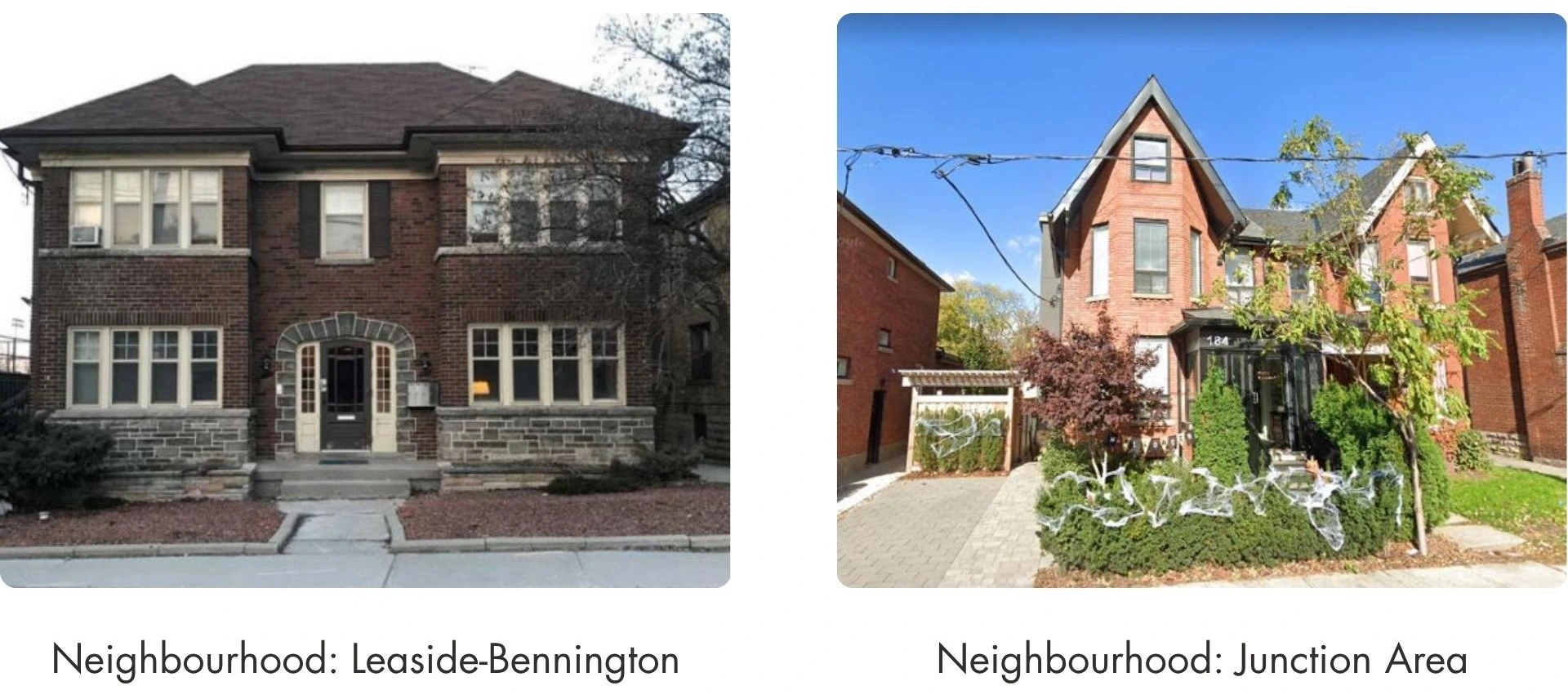
Image: City of Toronto Multiplex Study
Toronto's earlier multiplex study documented numerous examples of multi-unit housing integrated into established neighbourhoods.
Historic examples
A three-storey building on Palmerston Boulevard dating from the early twentieth century contains multiple dwelling units while maintaining the scale and architectural language associated with the surrounding residential street.
Other examples appear in neighbourhoods such as Leaside and Cabbagetown, where multi-unit residential buildings have existed for decades alongside detached and semi-detached houses.
These examples demonstrate that neighbourhood character and housing diversity are not necessarily opposites.
Toronto Sixplex Zoning Map
Thinking of converting your single-family home into a sixplex? See which areas currently permit six-unit multiplex development before planning your project.
Design determines how density feels
The number of dwelling units inside a building does not, by itself, determine how large or intrusive that building appears from the street.
Building height, setbacks, entrances, landscaping, massing, roof form, windows, and materials all influence how a multiplex fits into its surroundings.
This is one reason low-rise multiplex policy focuses on maintaining a residential built form rather than introducing mid-rise apartment buildings onto house streets.
House-scale design can accommodate several units
A multiplex can contain several homes while maintaining the general scale of a large detached house.
Features such as pitched roofs, front porches, landscaping, and appropriately located entrances can help the building relate to the surrounding streetscape.
The quality of the design therefore matters more than simply counting the number of units behind the front door.
Neighbourhood character is not static
The phrase “neighbourhood character” can sometimes imply that residential streets have always looked and functioned exactly as they do today.
Toronto's neighbourhoods have changed repeatedly over time.
Houses have been divided into apartments, additions have been constructed, laneway and garden suites have been introduced, families have become smaller, and different generations have used the same properties in different ways.
Additional housing can also allow more people to remain in established neighbourhoods as their needs change.
Seniors may want smaller homes without leaving their community. Adult children may want to live closer to family. Younger households may be able to rent in areas where detached ownership is financially inaccessible.
These are some of the housing objectives behind Toronto's broader multiplex strategy .
What about parking and infrastructure?
More households can create additional demand for parking, waste collection, utilities, transit, schools, parks, and other neighbourhood infrastructure.
The scale of that impact depends on where development occurs and how quickly housing is added.
Low-rise multiplex reform is generally intended to add housing incrementally within existing neighbourhoods rather than introduce the concentration of units associated with a high-rise development.
Transportation behaviour also varies significantly by location.
Multiplexes located near frequent transit, cycling infrastructure, employment, and local services may generate different parking demand from similar properties in more car-dependent areas.
It is therefore too simplistic to assume that every additional dwelling unit corresponds directly to another vehicle.
Could multiplex permissions increase the value of some properties?
Additional development rights can potentially increase what a buyer is willing to pay for a property that is particularly well suited to redevelopment.
But permission is not the same as feasibility.
A developer or investor still needs the project to work after accounting for acquisition, financing, construction, approvals, and expected revenue.
Toronto's NBLC analysis concluded that material land-value impacts from expanded low-rise multiplex permissions were unlikely to be widespread.
Some individual properties may become more attractive because of redevelopment potential, while many others will continue trading primarily based on their existing use as homes.
Property taxes are based on assessed value, not simply unit count
Another homeowner concern is whether zoning permission automatically creates a major property-tax increase.
Property taxes are based on assessed property value and the applicable tax classification rather than simply the theoretical maximum number of units permitted by zoning.
A property that physically changes or increases materially in value can eventually be assessed differently, but the existence of multiplex permissions does not mean every affected house automatically becomes taxed as though a sixplex has already been built.
What homeowners should take from the research
The available evidence does not support a simple conclusion that multiplex zoning lowers neighbouring home values.
Nor does it prove that every multiplex will improve a neighbourhood or increase surrounding values.
The more defensible conclusion is that property values remain primarily influenced by broader market conditions and the characteristics of the individual property and location.
Good design, appropriate scale, thoughtful planning, and gradual development all influence how additional housing integrates into established neighbourhoods.
Frequently Asked Questions
Will a sixplex next door lower my home's value?
Toronto's commissioned research did not identify evidence of material negative property-value effects simply from being located near multiplex housing. Home values are influenced by many factors, including location, interest rates, housing demand, property condition, and broader market conditions.
Does multiplex housing ruin neighbourhood character?
Not inherently. Toronto already contains many historic duplexes, triplexes, fourplexes, and other multi-unit homes integrated into low-rise neighbourhoods. Building scale, massing, landscaping, entrances, and architectural design influence how successfully a new multiplex fits into its surroundings.
Will it be harder to resell a home if multiplexes are allowed nearby?
The research cited in Toronto's multiplex studies does not establish that buyers broadly avoid neighbourhoods because multiplex housing is permitted. Buyers continue to evaluate factors such as location, schools, transit, property condition, lot characteristics, amenities, and redevelopment potential.
Can sixplex permissions increase the value of a property?
Additional development potential can increase the appeal of certain properties, particularly where the lot, location, existing building, and project economics make redevelopment feasible. However, zoning permission alone does not guarantee that a sixplex project is financially practical or that every affected property will experience the same value impact.
Will additional multiplexes create parking problems?
Parking impacts depend heavily on location, transit access, household characteristics, and the design of the project. Additional units can increase local transportation demand, but there is not a simple one-unit-to-one-car relationship. The impact needs to be considered in the context of the specific neighbourhood.
The bottom line
Expanded multiplex permissions represent a meaningful change to how some Toronto neighbourhoods can evolve.
Homeowners are reasonable to ask what that means for their own properties.
But the available research does not support the assumption that allowing sixplexes automatically reduces nearby home values or fundamentally changes a neighbourhood overnight.
Development tends to occur gradually, and the impact of an individual multiplex depends significantly on design, location, feasibility, and how well the building fits the surrounding community.
The more useful question is therefore not simply whether a property contains one home or several.
It is whether new housing is planned and designed well enough to become a durable part of the neighbourhood around it.
Need help with your property?
Tell us what you are considering and our team will help determine the right next step.
Thank you.
Your enquiry has been sent. A member of our team will be in touch shortly.