Long-Term Ownership
Buy-and-Hold Investors
Reliable day-to-day management for investors focused on steady rental income, tenant stability and long-term asset care.

Investment Property Management · Real Estate Investors
Investment property management gives real estate investors the leasing, operations, reporting and local oversight needed to manage rental assets consistently. Your portfolio can grow without every tenancy, repair, invoice and vacancy continuing to depend on you.
Investor Profiles
Investors turn to professional management at different stages — holding a rental long term, scaling a portfolio, managing from another city or country, stabilizing a value-add asset, or transitioning away from another manager.
Long-Term Ownership
Reliable day-to-day management for investors focused on steady rental income, tenant stability and long-term asset care.
Portfolio Growth
Consistent processes, reporting and owner controls across multiple properties so growth does not create fragmented operations.
Multi-Unit Ownership
Coordinated leasing, tenant communication, maintenance and reporting across properties with multiple units and shared systems.
Remote Ownership
Local oversight, responsive tenant support and clear reporting for investors who do not live near the property or are based outside Canada.
Repositioning
Operational support through renovation, lease-up and stabilization, followed by a clean transition into ongoing management.
Management Transition
A structured handoff of leases, tenant records, keys, vendors, financial information and open issues with minimal disruption to residents.
Portfolio Challenges
The systems that work for one rental often become inconsistent as the investor adds units, buildings, vendors and reporting requirements.
Pricing, presentation, screening and timing directly affect income and tenancy quality.
Different vendors, records and processes make it harder to understand what is happening across the portfolio.
Investors need context, documentation and approval controls—not simply a stream of invoices.
Property-level and portfolio-level information should support decisions without requiring manual consolidation.
The investor should not become the bottleneck for every tenant question and routine operating decision.
Newly acquired or renovated properties need a clear handoff into leasing, tenant operations and ongoing management.
What Investors Can Hand Off
Instead of coordinating separate vendors, inboxes and spreadsheets, investors get one accountable management structure with consistent approval rules, documentation and reporting across the portfolio.
Market-informed pricing, listing preparation, showings, screening, lease coordination and vacancy planning.
Explore Leasing ServicesRent intake, arrears tracking, deposits, statements, invoices and organized year-end records.
Explore Rent CollectionWork-order triage, vendor coordination, owner approvals and 24/7 emergency support.
Explore Maintenance ServicesCoordination of property expenses, recurring bills and approved invoices, with organized records for owner reporting.
Explore Bill Payment ServicesOrganized property-level information and visibility across several rentals.
Explore the Client PortalSupport for investors evaluating and acquiring additional rental properties through LandLord Realty.
Explore Investment Property BuyingInvestment Property Types
LandLord manages more than 2,500 rental units across Toronto and the GTA, giving investors access to a team with operating experience across condos, houses, secondary suites, multiplexes and multi-unit residential properties.
Different assets create different leasing, maintenance, expense and reporting demands. The management system should reflect the property—not force every investment into the same process.
Individually owned suites with building rules, move-in procedures and condo-specific coordination.
Detached, semi-detached and freehold rentals with full-property maintenance responsibilities.
Basement apartments, internal suites, laneway homes, garden suites and other additional residential units.
Duplexes, triplexes, fourplexes and other small multi-unit properties with shared systems.
Several rental units requiring coordinated leasing, maintenance, records and building-level reporting.
Investment Performance
The objective is not simply to collect rent. It is to reduce avoidable vacancy, create a clean operating history and preserve the ability to hold, refinance, renovate or sell.
Consistent leasing, rent administration and follow-up support more predictable cash flow.
Inspection, repair and invoice records help investors understand what has happened at each property.
The investor is not required to coordinate every tenant question, vendor visit or notice.
Organized management supports a later refinance, renovation, sale or portfolio expansion.
Investor Onboarding
A structured onboarding process creates consistent records, approval rules and reporting across the assets being transferred.
Confirm assets, occupancy, lease status, current issues, investment horizon and immediate priorities.
Organize leases, rent history, deposits, invoices, keys and owner reporting details.
Set maintenance approvals, vendor procedures, emergency thresholds and communication expectations.
Introduce payment, maintenance and communication workflows across the portfolio.
Set leasing priorities, inspection timing, reporting cadence and stabilization actions.
Client Visibility
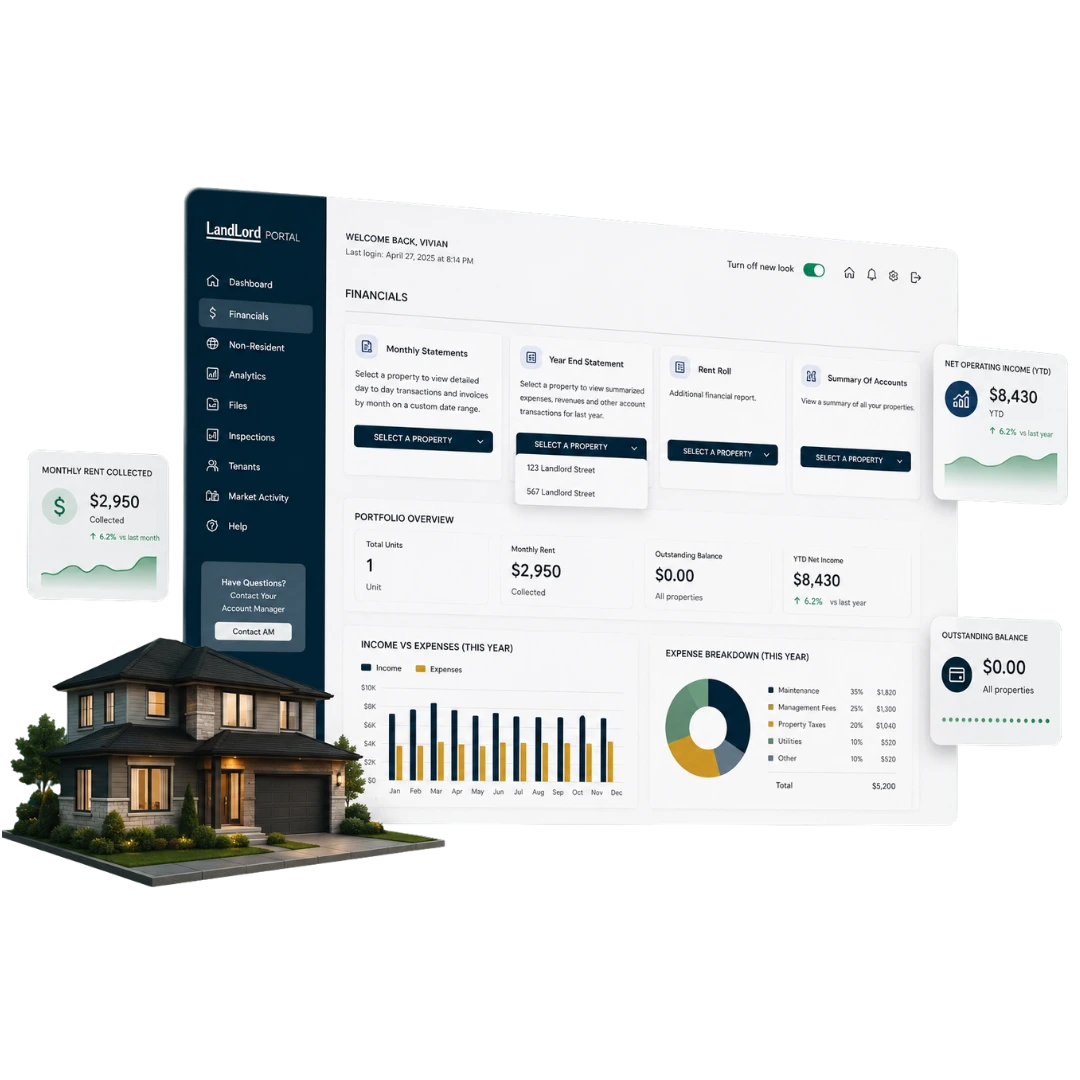
Investors can monitor portfolio activity, generate customizable reports, review performance analytics and access the statements, invoices, inspections and maintenance records behind each property through LandLord’s secure client portal.
Service Areas
Explore local coverage for the city or Toronto district where the rental property is located.
Investor FAQs
Investment property management can include leasing, tenant communication, rent administration, maintenance coordination, inspections, property records and reporting across one or several rental assets.
Yes. Investors can use consistent systems and reporting across multiple units, houses or buildings.
In many cases, yes. Existing tenancies can continue while leases, payment records, keys, notices and maintenance history are transferred.
Yes. The team can help with rental pricing, leasing, tenant setup and the transition into ongoing operations.
Approval expectations and thresholds are established during onboarding. Emergency work may require immediate action, while larger non-urgent repairs are normally discussed.
Yes. The LandLord client portal can provide access to statements, invoices, inspection photos, maintenance activity and property documents.
Yes. LandLord provides local operations and reporting through its non-resident property-management service and can coordinate the management side of ownership with the investor’s tax professionals.
Pricing depends on the number and type of properties, location, occupancy and required service scope. A portfolio review is the best starting point.
Scalable Investment Property Management
Share the properties, current occupancy, immediate issues and growth plans. We’ll outline where professional management can remove friction.