Estimated reading time: 12 minutes
Allowing sixplexes (small apartment buildings with up to six units) in residential neighbourhoods is a big change for Toronto, and it’s natural for homeowners to worry. You might have heard fears that multiplex housing will hurt your property value or spoil your street’s character.
The good news? Studies from Toronto and other cities show that multiplex zoning does not lower nearby home values — and it may even bring benefits to your community. Below, we debunk common myths, share expert insights, and explain how well-designed sixplexes can blend into neighbourhood streetscapes.
Homeowner Fears About Sixplexes
Many Toronto homeowners share similar worries about the new sixplex permissions. Let’s summarize the most common concerns:
- “My property value will decline.” A top fear is that a sixplex next door will make your home worth less, hurting your investment and resale value.
- “Our neighbourhood’s character will be ruined.” Residents cherish the look and feel of their streets, and worry multiplexes will be ugly or out-of-scale.
- “It will be harder to resell my home.” Some believe that allowing multiplexes will shrink the pool of buyers interested in single-family homes.
- “Parking, traffic and noise will get worse.” More units on the street could mean more cars, more congestion, and more strain on local infrastructure.
These fears are understandable — your home is likely your biggest asset. However, as we’ll see, the evidence tells a different story. Toronto’s own studies and experiences in other cities show that these worst-case scenarios haven’t materialized.
What Research Says About Property Values
Let’s tackle the biggest worry first: property values. The idea that multiplexes will tank nearby home prices has been extensively studied, and the findings are reassuring.
Major Studies: Upzoning Has Little Impact on Prices
Toronto’s city planning division reviewed the literature and commissioned an independent analysis on upzoning impacts — including effects on property values — as part of the sixplex study. The conclusion: allowing more units has minimal to no negative impact on home prices. Planners found that broader market forces (overall supply and demand, interest rates, etc.) determine property values far more than zoning changes.
NBLC Report: Sixplex Next Door ≠ Lower Home Price
Toronto hired N. Barry Lyon Consultants (NBLC) to examine what happens when a single-family lot is upzoned to allow fourplexes or sixplexes. NBLC looked specifically at whether nearby property values drop. They reported “no evidence of any material property value changes to neighbouring property values due to proximity to multiplexes.”
Case Study — Minneapolis: Values Rose After Reform
Some upzoning can even enhance property values modestly. When Minneapolis ended single-family-only zoning and allowed triplexes citywide, researchers found home sale prices actually increased by about 3–5% in the affected areas. Greater development potential gave each lot a bit more value, rather than scaring buyers away.
Any small initial uptick in land value from new zoning tends to be balanced out over time by increased housing supply, which improves affordability citywide. Toronto’s planners point out that as more multiplexes gradually get built, the added housing options help meet demand and ease price pressures in the long run.
Why a Slow, Targeted Rollout Keeps Markets Stable
NBLC concluded that “material impacts on property values due to low-rise multiplex permissions are unlikely” precisely because these projects take time, money, and the right conditions to make sense. Converting a house to a sixplex typically only makes financial sense on larger lots or rundown homes near transit — situations that are limited in number. This means your neighbourhood won’t turn overnight into a developer free-for-all.
Lessons from Other Cities
Toronto isn’t the first city to introduce gentle density in house neighbourhoods. Cities like Portland, Minneapolis, Vancouver, and Edmonton have all legalized multiplex housing forms in recent years, and the common theme is that neighbourhoods have not seen the doom-and-gloom outcomes opponents feared.
Minneapolis, Minnesota
After Minneapolis allowed duplexes and triplexes on former single-family lots as part of the 2018 “Minneapolis 2040” plan, there was no collapse in home values — quite the opposite, with a slight increase as noted above. Minneapolis also did not see an exodus of homeowners or a rapid change in neighbourhood character; development has been slow and steady. This aligns with wider U.S. research showing that even large multifamily developments typically do not negatively impact the sales price of nearby single-family homes.
Portland, Oregon
Portland’s 2020 Residential Infill Project allowed up to four units by right on most lots, and up to six if some are affordable, effectively legalizing houseplexes across the city. Since then, Portland has seen dozens of “missing middle” homes take shape, from fourplexes to cottage clusters, without eroding single-family home values or neighbourhood desirability.
Vancouver, BC
Vancouver began allowing duplexes in all single-family zones in 2018, and moved to permit 4-unit multiplexes on standard lots (up to 6 on larger lots) in 2024. City staff in Vancouver expect little impact on property values for most low-density homes. As their public FAQ notes, “for most properties in low-density areas, multiplexes would not impact property values. Single detached houses and duplexes will continue to be the primary driver of land values.”
Edmonton, Alberta
Edmonton implemented one of Canada’s boldest zoning changes, allowing up to eight units per lot citywide as of 2024, with strong uptake of duplexes, fourplexes, and more reported since. There have been no reports of property value chaos or neighbourhood meltdowns. Toronto’s sixplex move is more modest by comparison — a maximum of six units, and only in select wards to start.
The takeaway from other cities is clear: legalizing multiplexes does not destroy neighbourhoods or sink home values. Property values continue to follow broader market trends, largely independent of unit count next door.
Design and Character: Sixplexes That Blend In
Beyond property prices, a huge part of homeowner concern is neighbourhood character. The reassuring news is that sixplexes can be designed to blend seamlessly into residential streetscapes — and Toronto’s policies include rules to ensure that happens.
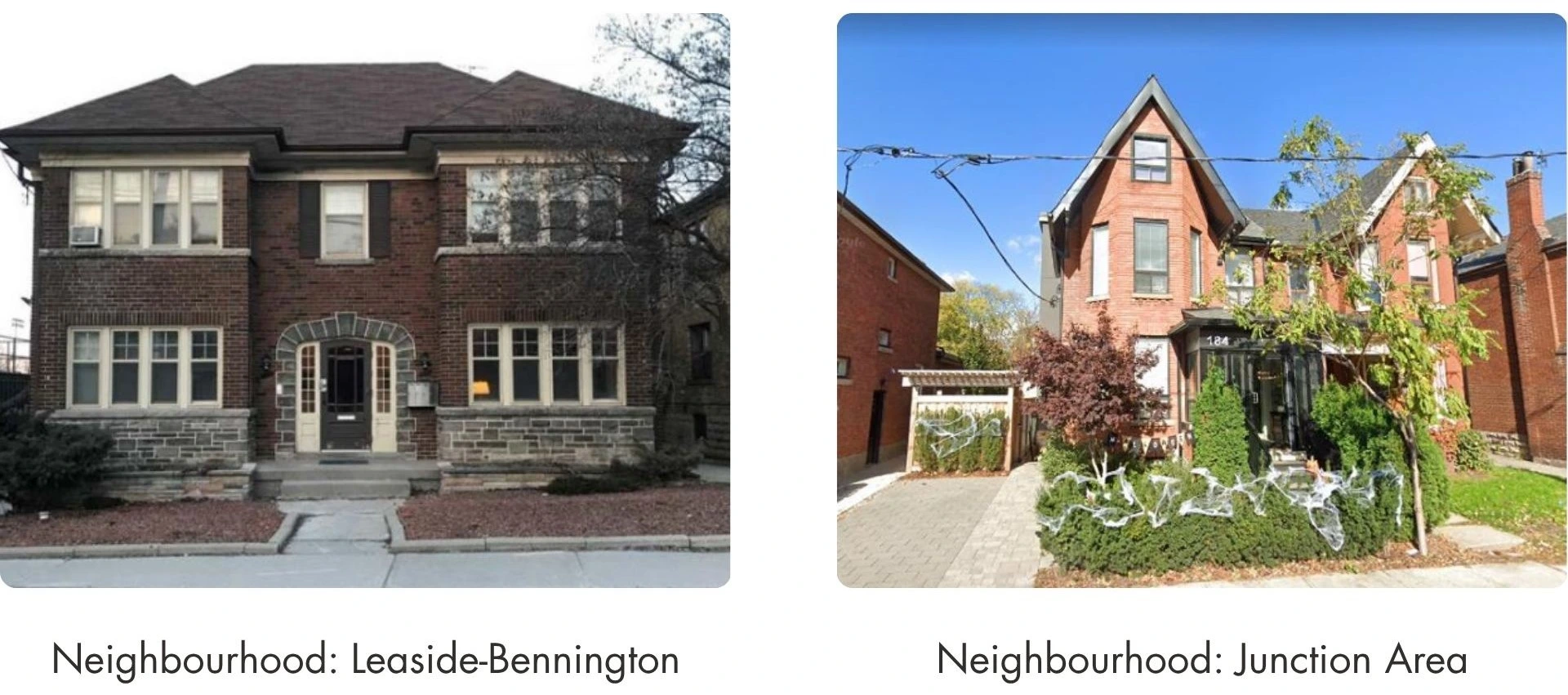
Image: Expanding Housing Options in Neighbourhoods – Multiplex Study – Examples of Multiplexes in Toronto
Toronto’s Historic House-Plex Legacy
Toronto has numerous examples of “house-plexes” built in past eras that fit right in. For instance, a 1914-built three-storey building at 337 Palmerston Blvd. contains six homes yet appears, to a casual passerby, as just another stately Edwardian house on the block.
Heritage District Case Studies: Leaside & Cabbagetown
In the Leaside area, a Tudor-style fourplex from 1936 was designated a heritage property — not just for its architecture, but because it contributed to the neighbourhood’s character by providing a range of housing typologies within the same scale and style as its single-family neighbours. In Cabbagetown, a semi-detached from 1890 containing three units is part of a Heritage Conservation District — proof that even 130 years ago, multi-unit homes coexisted with the historic character of a neighbourhood.
These examples show that Toronto’s neighbourhood character has always included multiplexes in some form.
Toronto Sixplex Zoning Map
Thinking of converting your single-family home into a sixplex? See exactly which wards currently allow it before you plan your project.
Modern Design Rules Keep Sixplexes House-Sized
City planning staff have emphasized that new multiplex buildings should “respect and reinforce the general physical patterns in Neighbourhoods,” and that the multiplex form is designed to fit within the existing physical character. In practice, this means a sixplex can look like a large version of a house, often just 2.5 or 3 storeys tall. Toronto’s zoning update limits multiplex height to roughly 10 metres in most low-rise zones — so you won’t get a towering apartment block on a street of bungalows.
Architectural Details Can Further Help Multiplexes Blend In
Pitched roofs, front porches facing the street, and complementary landscaping and materials — all the features associated with “house”-type dwellings — can be incorporated into a sixplex design. City staff involved in the Ward 23 sixplex pilot reported that these buildings are often “indistinguishable from the surrounding single-detached homes” once built.
More residents can also enhance a neighbourhood’s character and vitality: more kids for local schools, more customers for the corner café, and better use of the park down the street. Toronto’s pilot study in Scarborough noted that gentle density of this kind can help stabilize declining populations and support local businesses.
Design Standards Keep Sixplexes Invisible
Toronto planner Gil Meslin — who coined the term “Yellowbelt” to describe the city’s restrictive single-family “Neighbourhoods” zoning — has long argued that the best density is often the kind residents don’t even notice. Portland has demonstrated something similar: with form-based codes and design standards, middle-density housing can be practically invisible as a threat to aesthetics or character. Developers there have observed that people often fear what they think a multiplex will look like; once they see actual examples in their neighbourhood, much of the concern subsides.
As Councillor Gord Perks put it during Toronto’s June 2025 council debate on the policy: “Cities grow or die, neighbourhoods grow or die. It is unique in North America that we have neighbourhoods that have never been reinvested in… If the communities in the inner suburbs want to thrive, they need to attract reinvestment, and that reinvestment comes from reforms like this.”
Economists and Planners Weigh In
It’s not just City staff or developers saying positive things — independent experts back up the case that multiplexes won’t harm homeowners.
Supply & Demand — Not Unit Count — Sets Property Values
Housing economists often note that what drives home values is overall supply and demand, not whether your neighbour’s house has one unit or six. A review by the Connecticut Department of Housing found “the available research is fairly strong that multifamily housing… does not reduce property values if well-designed and appropriate to the neighborhood.” In Toronto’s context, sixplexes are much smaller in scale than large apartment complexes, reinforcing that there’s little reason to expect a negative effect on values.
Realtors See Buyers Embracing Sixplex Neighbours
Whereas some homeowners worry buyers won’t want to live near a multiplex, agents point out that many buyers don’t mind — or even appreciate — a neighbourhood that offers diverse housing. A street with a few multiplexes still has the same schools, parks, and amenities that draw people in, and more families and eyes on the street can improve safety and vibrancy.
Multiplexes Build Intergenerational Neighbourhood Stability
Ward 23 (Scarborough North) Councillor Jamaal Myers, who championed the sixplex pilot in his ward, has consistently emphasized the community benefits: the pilot allows for the development of up to six residential units per property, creating housing options for seniors looking to downsize while staying close to family, and for younger residents to remain in the neighbourhood they grew up in.
This kind of intergenerational stability can support property values by keeping communities desirable for a broad range of ages and incomes rather than hollowing out.
Could Sixplex Zoning Boost Your Land Value?
Some homeowners are concerned not about losing value, but about assessments — and property taxes — going up. It’s true that a lot with more development potential might see its market value increase modestly, as seen in Minneapolis. However, Toronto’s situation is unique: even before sixplex legalization, most properties already could host 2, 3, or 4 units under 2023’s fourplex reform. The jump from four units to six is small, and NBLC found it’s “unlikely to have a meaningful land value impact.” The City also classifies 1–6 unit properties the same for tax purposes, so a sixplex pays the same tax rate as a house, just on a potentially higher assessed value.
Frequently Asked Questions
No. Extensive research and Toronto’s own commissioned studies show that nearby multiplexes do not hurt single-family home prices. What really drives your home’s value are broader market factors — overall housing demand, interest rates, the economy — not whether your street allows multiple units. In some cases, giving land more potential uses can modestly increase its value, as seen in Minneapolis, but no study has found values crashing because of nearby multiplexes.
Not when it’s designed thoughtfully. A sixplex is typically a house-sized building divided into multiple units, and Toronto requires height limits (roughly 3 storeys) and setbacks that keep sixplexes similar in scale to large detached homes. City staff have reported these buildings are often indistinguishable from surrounding single-detached homes once built.
There’s no evidence that homebuyers avoid areas with multiplexes — some of Toronto’s most sought-after neighbourhoods, like the Annex and Cabbagetown, already quietly contain duplexes and triplexes. Many buyers prioritize location and community amenities over unit count next door, and knowing an area is multiplex-permissible can even expand your pool of potential buyers.
Toronto’s planners found that added density from sixplexes tends to make more efficient use of existing infrastructure rather than overload it, since many Toronto neighbourhoods have actually lost population over the past 20 years. The City has also eliminated minimum parking requirements for multiplexes, and six households typically own a comparable number of vehicles to a couple of detached homes — not an overwhelming increase.
Conclusion: Embracing Gentle Density with Confidence
Change can be unsettling, especially when it comes to our homes and communities. But the introduction of sixplexes in parts of Toronto is a carefully considered, research-backed change — one that aims to improve housing options without harming existing homeowners.
The fears that property values will plummet or neighbourhoods will deteriorate have been disproven by studies and the real experiences of cities that have gone down this road already. Your home’s value is unlikely to fall because of a nearby multiplex — if anything, a thriving, updated neighbourhood with a mix of housing can make it more attractive.
“The next time someone says sixplexes will lower property values, you’ll have the facts — and the citations — to answer with confidence.”
Toronto’s sixplex policy, adopted by council in June 2025, currently applies in nine wards across Toronto and East York plus the Ward 23 (Scarborough North) pilot area, with the remaining wards able to opt in — a deliberately incremental rollout rather than an overnight citywide change. As homeowners, we can take confidence in the fact that City staff, planners, and independent experts have done their homework.
Thinking of converting your single-family home into a sixplex? LandLord has guided Toronto homeowners through hassle-free multiplex conversions — handling zoning, design, and tenant placement under one roof. Book a complimentary feasibility call →
Sources: Housing Accelerator Fund: Expanding Permissions in Neighbourhoods for Low-Rise Sixplexes, Expanding Housing Options in Neighbourhoods Multiplex Monitoring Program, APA on Minneapolis upzoning, City of Vancouver Multiplex FAQs, More Neighbours Toronto, City of Toronto Heritage Archive Multiplex Study, Storeys on the June 2025 council vote, Connecticut Department of Housing, and CBC News.