
Estimated reading time: 12 minutes
Most people assume multiplexes lower property values and damage neighbourhoods. The data tells a different story, and the real risk isn’t density, it’s how it’s done.
Every time a multiplex proposal lands in a Toronto neighbourhood, the same concerns surface within days: falling property values, parking gridlock, bins overflowing, strangers next door who don’t care about the street. These fears drive petition drives, planning objections, and heated committee meetings — and they’re reshaping the city’s housing conversation in real time.
But here’s the problem: most of the opposition is built on assumptions, not evidence.
This article walks through what the research actually shows — on property values, neighbourhood safety, and the quality of street life — so that landlords, homeowners, and investors can form a clear-eyed view of what multiplexes do and don’t do to a neighbourhood.
The NIMBY Response Is Predictable — and Often Misses the Point
When residents hear “multiplex,” they tend to picture the worst version: an oversized box crammed onto a lot designed for one family, six cars competing for two parking spots, and a constant churn of transient tenants with no stake in the street.
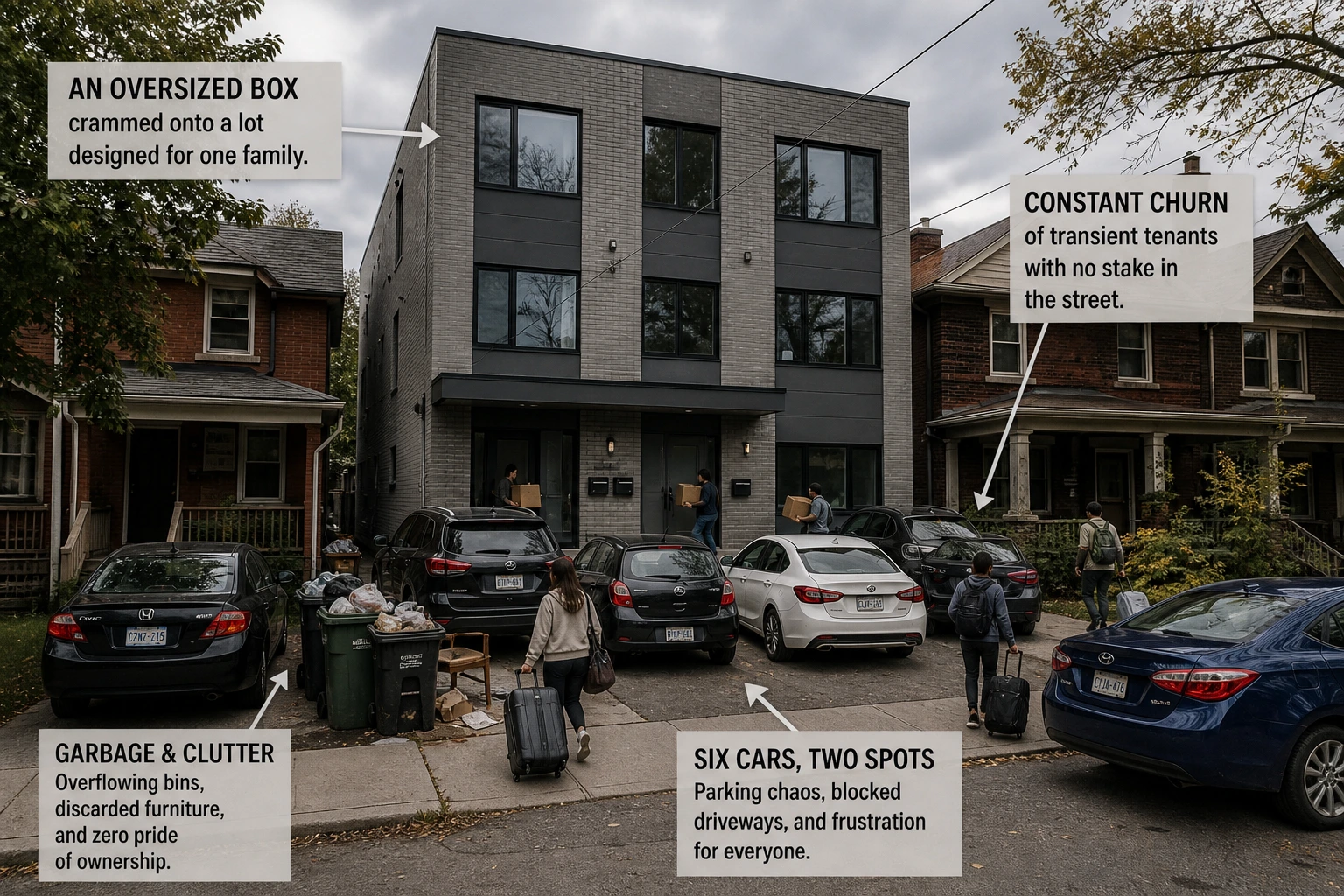
Those fears rarely get articulated in planning meetings, but they drive a lot of opposition.
The 501 Palmerston Boulevard case is the clearest recent example. In September 2025, developer GreenStreet Flats applied to replace a three-unit Edwardian home, five minutes from Bathurst subway, with a 10-unit building. Residents launched a petition seeking heritage designation for the entire street. The city’s committee of adjustment rejected the proposal unanimously in November.
But that’s not where the story ended.
The developer redesigned the project, addressed the built-form concerns, scaled it back, and reapplied. In March 2026, it was approved. Committee chair Larry Clay described the revised plan as “significantly improved.”
The housing need didn’t disappear. The opposition didn’t either. What changed was the quality of the proposal.
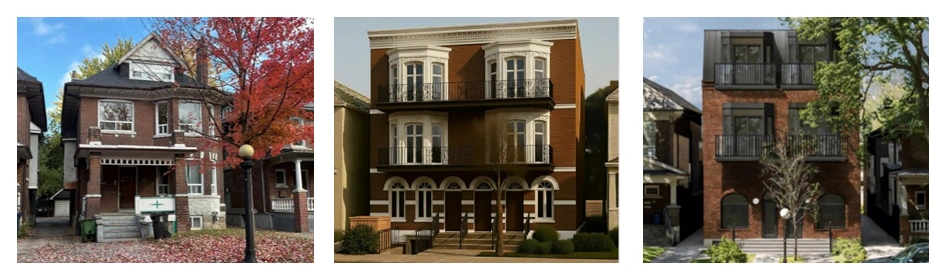
501 Palmerston Boulevard – Green Street Flats
A few blocks north, at 337 Palmerston, an Edwardian building from 1914 quietly houses six families. Most people walking by assume it’s a single-family home. That building — in that location, at that density — would be illegal to build today under current zoning.
“That building — in that location, at that density — would be illegal to build today under current zoning.”
Palmerston isn’t an argument against multiplexes. It’s an argument for better design and serious execution.
What the Research Says About Property Values
The most persistent fear is also the most directly contradicted by evidence.
Toronto’s own commissioned research found no material impact. The City of Toronto engaged N. Barry Lyon Consultants (NBLC) to assess whether neighbouring property values change when a multiplex goes in nearby. Their conclusion was unambiguous: no evidence of any material property value changes to neighbouring properties due to multiplex proximity.
Toronto’s planning analysis of the sixplex zoning changes reinforced this, finding that broader market forces, interest rates, overall supply and demand, are the dominant drivers of residential property values, not whether the house next door has two units or six.
“Overall, results suggest that Toronto’s multiplex reform may have been associated with modest relative price increases for lots more likely to accommodate redevelopment.”
— Interpreting Price Signals from Toronto’s Multiplex Zoning Reform | TRREB
Minneapolis provides the most detailed post-reform data available. When the city eliminated single-family-only zoning, researchers found that home sale prices near rezoned areas actually increased by 3 to 5 percent. Not because buyers suddenly valued triplexes, but because development potential added a modest premium to each lot. A later peer-reviewed study found equally important evidence: post-reform, both home prices and rents grew more slowly in Minneapolis than in a comparable control city. More supply moderated price increases across the board.
Vancouver, Portland, and Edmonton have all gone through similar upzoning reforms. In none of those markets did a property value collapse follow. Vancouver’s city staff noted that for most low-density properties, multiplex permissions would have little to no impact on assessed values.
The Appraisal Principle Most People Haven’t Heard Of
There’s a real estate valuation concept that ties this all together.
It’s called the Principle of Progression and Regression.
PRINCIPLE OF PROGRESSION AND REGRESSION
Progression holds that a lower-value property is pulled upward when surrounded by well-maintained, higher-value properties. Regression works in reverse — a superior property gets dragged down by deteriorating or neglected neighbours.
Applied to multiplexes: a well-designed, professionally managed multiplex represents a reinvestment in a property. New construction. New households. Active upkeep. That creates a Progression effect for the surrounding street.
An unmanaged, deteriorating property, whether it’s a multiplex or a single-family home, creates a Regression effect. The variable isn’t unit count. It’s condition and care.
What Actually Changes on the Street
If property values aren’t the real risk, what does change when a neighbourhood adds density?
The most significant shift isn’t physical, it’s demographic. Instead of one household occupying a large lot, three, four, or six households now have access to a neighbourhood they likely couldn’t afford otherwise: a downsizer who wants to age in place, a young professional priced out of detached homes, a newcomer family that needs stability near transit and schools.
CMHC describes missing middle housing, the 2-to-6 unit category that multiplexes fall into, as a layer of supply that can be delivered within existing neighbourhoods, often faster and with less capital than larger projects, while broadening choices for households priced out of detached homes but unwilling to trade space for a high-rise apartment.
The scale of what’s happening in Toronto is worth keeping in perspective. Toronto and Vancouver combined accounted for only 12.6% of missing middle housing starts across six major Canadian cities in 2024, and Toronto’s share of that is the smaller of the two. Calgary and Edmonton alone drove 67% of all missing middle construction that year. This is not an overnight flood of multiplexes. It is a gradual correction in a city that has been underbuilding this housing type for a generation, and one that still has significant structural and regulatory barriers to overcome before it catches up.
And more households on a street can strengthen it. More people using local shops. More transit riders helping justify service frequency. More children keeping local schools viable. More eyes on the street, what urban planners call passive surveillance. More community.
Neighbourhoods losing population in lower-density areas, and Toronto has several, are not being protected by maintaining single-family-only zoning. They’re being slowly hollowed out. Thoughtful gentle density can reverse that.
Why Management Is the Most Important Variable
Here’s the part of the multiplex conversation that almost no one discusses, and it may be the single most consequential factor.
“The perception of a multiplex is not set at the permit stage. It’s set by whoever is running it after tenants move in.”
The landmark research on this comes from a 1997 study by Robert Sampson and colleagues, published in Science. Their analysis found that crime rates are lower in neighbourhoods with high “collective efficacy”, defined as mutual trust among neighbours combined with a shared willingness to intervene for the common good. Critically, this held true even in lower-income areas. The determining factor was not poverty or density. It was the strength of the community fabric itself.
A 2020 Wharton School study at the University of Pennsylvania reinforced this finding: measurable community vibrancy, neighbours interacting, participating in shared activities, was consistently associated with lower crime rates across Philadelphia neighbourhoods, independent of income or density levels.
What does this mean for multiplexes? A well-managed building creates the conditions for collective efficacy. Tenants who feel accountable to each other and to the street. A landlord or property manager who communicates expectations clearly and enforces them consistently. Common areas that are maintained and used with care.
An unmanaged building does the opposite. No accountability. No systems. No one paying attention when something goes wrong. And the neighbours notice, every day.
The Garbage Bin Test
It sounds trivial, but it illustrates the point precisely.
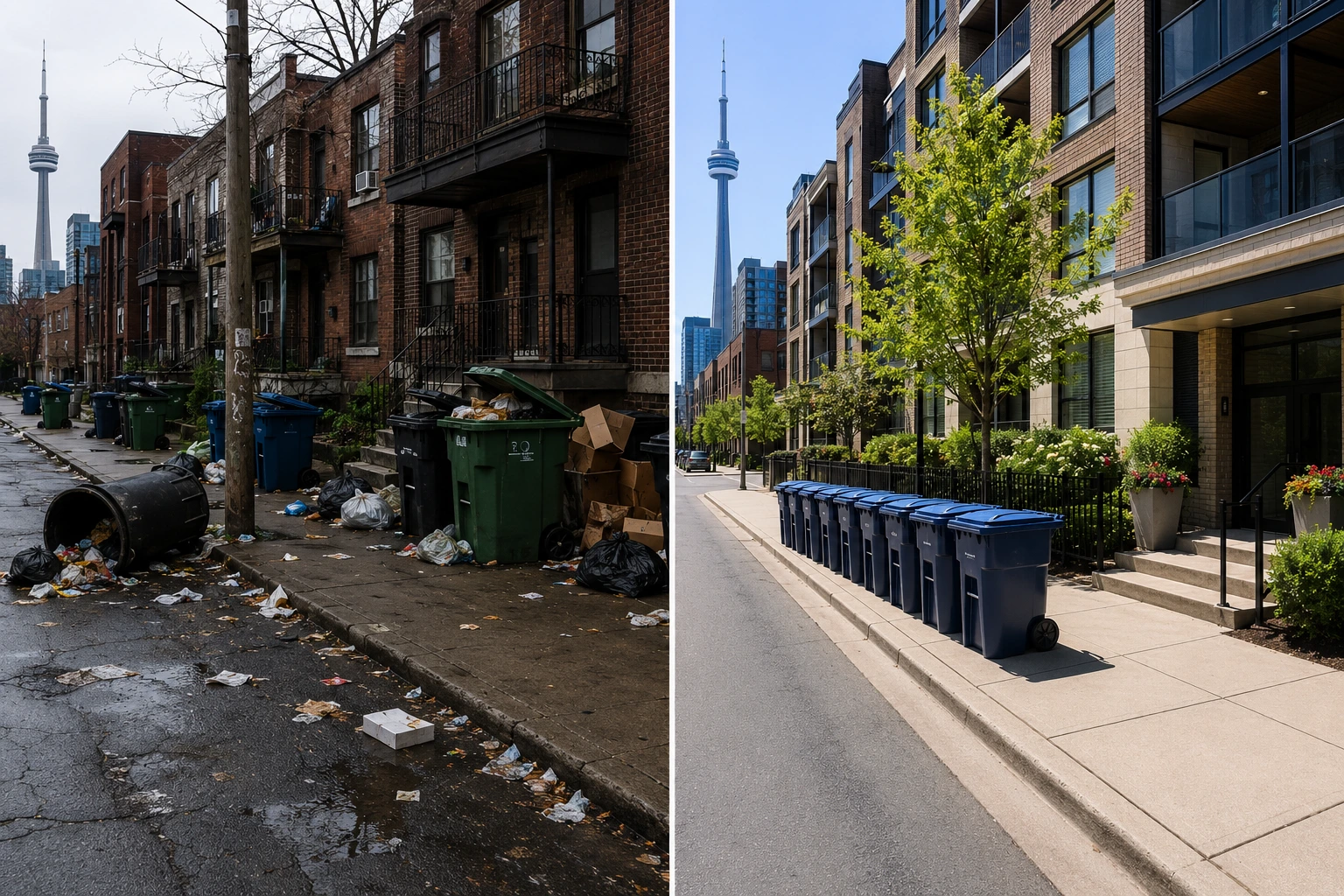
On a professionally managed property, bins are in the designated enclosure, tenants are briefed on collection schedules, and waste management is part of routine operations. From the sidewalk, the building looks like any other well-kept home on the block.
On an unmanaged property, there’s no system, no communication, and tenants improvise. Bags accumulate. Bins migrate. Someone leaves a mattress near the shared entry. The neighbours see it. They talk about it. And it becomes the story of what multiplexes do to a neighbourhood.
These everyday signals are what form the public perception of multiplexes, not the zoning bylaw, not the development approval. The day-to-day operation.
“If every multiplex in Toronto were professionally managed, most NIMBY complaints would disappear.”
Not because density concerns are baseless, but because the most visible problems associated with multiplexes are operational problems, not density problems. They’re solvable.
That’s the real case for professional multiplex property management: not as a nice-to-have, but as the factor that determines whether a multiplex earns its place on the street, and whether the Progression principle works in your favour or the Regression principle works against you.
The More Honest Question
A neighbourhood that never changes is not necessarily being preserved. Sometimes it’s being frozen. And when a neighbourhood freezes, the people left out are almost always renters, younger households, newcomers, downsizers, and families that need more options than a condo tower but can’t access a detached home.
That doesn’t mean every multiplex proposal is appropriate, or that every site is suitable for the density proposed, or that every landlord operating multi-unit housing has the systems to do it well.
But the assumption that multiplexes automatically degrade a street is too blunt an instrument. The better question, the one that actually leads to better outcomes, is: what kind of multiplex is being built, and how will it be operated after construction is complete?
There is a meaningful difference between adding units and creating housing that works.
A multiplex that earns its place on the street does three things: it fits the physical character of the block, it meets real tenant demand in the neighbourhood, and it’s managed in a way that protects the property, the tenants, and the community around it.
The Bottom Line for Toronto Landlords and Investors
Based on the available evidence, from Toronto’s own commissioned research, Minneapolis post-reform data, and comparative analysis across Vancouver, Portland, and Edmonton, multiplexes don’t ruin neighbourhoods. Poorly executed multiplexes create problems. The distinction matters.
The risk isn’t density. The risk is density done badly. And that’s a solvable problem.
At Landlord Property & Rental Management, we evaluate multiplex projects from both sides of the ledger: development feasibility and long-term rental operations. Building the units is only half the equation. The real test is what happens after people move in.
If you’re exploring a multiplex conversion or want to understand your property’s potential, the starting point is a feasibility review that covers the zoning, the street context, the tenant demand, and critically, the long-term management plan. Because the goal isn’t just more doors. It’s a rental property that works for the owner, the tenants, and the neighbourhood.
Frequently Asked Questions: Multiplexes and Property Values in Toronto
No. Toronto’s own commissioned research by N. Barry Lyon Consultants found no evidence of any material property value changes to neighbouring properties due to multiplex proximity. Broader market forces such as interest rates and overall supply and demand are the dominant drivers of residential property values, not whether the house next door has two units or six.
Minneapolis saw home sale prices near rezoned areas increase by 3 to 5 percent after eliminating single-family-only zoning. A later peer-reviewed study found that both home prices and rents grew more slowly in Minneapolis than in a comparable control city, meaning more supply moderated price increases across the board. Vancouver, Portland, and Edmonton went through similar upzoning reforms with no property value collapse in any of those markets.
Progression holds that a lower-value property is pulled upward when surrounded by well-maintained, higher-value properties. Regression works in reverse, a superior property gets dragged down by deteriorating neighbours. A well-designed, professionally managed multiplex represents a reinvestment in a property, creating a Progression effect for the surrounding street. The variable is not unit count, it is condition and management quality.
No. Toronto and Vancouver combined accounted for only 12.6% of missing middle housing starts across six major Canadian cities in 2024, with Toronto’s share being the smaller of the two. Calgary and Edmonton drove 67% of all missing middle construction that year. Toronto has been underbuilding this housing type for a generation and still faces significant structural and regulatory barriers.
Missing middle housing refers to the 2-to-6 unit residential category, including multiplexes, triplexes, and fourplexes, that sits between single-family homes and high-rise apartments. CMHC describes it as a layer of supply that can be delivered within existing neighbourhoods, often faster and with less capital than larger projects, while broadening housing choices for households priced out of detached homes.
Research by Robert Sampson published in Science found that crime rates are lower in neighbourhoods with high collective efficacy, mutual trust and shared willingness to intervene. A well-managed building creates the conditions for that. Tenants who feel accountable to each other, a landlord who enforces expectations consistently, and maintained common areas all contribute to community fabric. An unmanaged building does the opposite, and the neighbours notice every day.
Three things: whether it fits the physical character of the block, whether it meets real tenant demand in the neighbourhood, and whether it is managed in a way that protects the property, the tenants, and the surrounding community. The risk is not density, it is density done badly. That is a solvable problem.
Sources: N. Barry Lyon Consultants / City of Toronto (2025); City of Toronto Sixplex Study (2025); Kuhlmann / APA Journal (2021); GLO Discussion Paper No. 1629 / EconStor (2024); City of Vancouver Multiplex FAQ (2023); Sampson, Raudenbush & Earls, Science Vol. 277 (1997); Sinchaisri & Jensen, Wharton / UPenn (2020); CMHC Missing Middle Housing Development in Canada (2025); TorontoToday.ca (2025–2026).